The last few pages

In the last week I have finished two books-in-progress, written up a couple of others for my reading journal, and come to the last chapter of a huge book I started reading before the pandemic began. I should never write about tasks before I actually finish them, so I’ll defer any discussion about that particular book until after I have turned the last page, closed the 78-year-old cover, and returned the book to the university library.

One of the books I wrote about in my journal was one that I ended up enjoying, but had mixed feelings about overall. I loved the ending, as improbable as it was, but I found the middle chapters a bit of a slog to read. When I looked back upon the book as a whole, I felt that the main character went through the plot surviving on luck and chance more than anything else; that’s not a valid way to survive a novel set during World War II. I kept thinking that I could do better than this. Well, is it fair to say that about someone else’s [checks Amazon listing] ninth published novel when I haven’t published any of my own fiction since [checks mental records] 1984? I didn’t do better than this; I wasn’t even competing.

Right now I’m wrestling with the making of music and writing and art. My goodness, I sure want to be able to make THE music or write THE story or create THE art. What I need to get comfortable with is just making music and writing and art, and not stopping. Eventually it will all get better, and the body of work will become my music, my writing, and my art. The quality of it then isn’t anything I need to worry about now.

#remind, remind, remind

Anyway. Here are the lovely passages I marked from one of the books I finished this weekend.

The construction of identity comes about through opposition, through negation. It’s as though we’re incapable of understanding who we are, and have therefore opted for the simpler and immediate question: who are we not?

…we are unresolved creatures, and it is only friendship that makes us compete.

It’s no surprise that the first boast of the gods is always their immortality, a condition for overcoming the swamp of inhibition.

…love, which offers you the most sublime escape from reality together with its perfect opposite — it’s the only reality from which you don’t have to feel the need to escape.

For I fear it is true that we are born a second time, when we reach our early twenties after a long gestation period.

It may be worth noting that all of the above quotations were thoughtfully translated from the author’s native Italian.

In other news, I listened to the voice that told me to go to a particular thrift shop to find owls. This is what I found, which was one of two pieces:
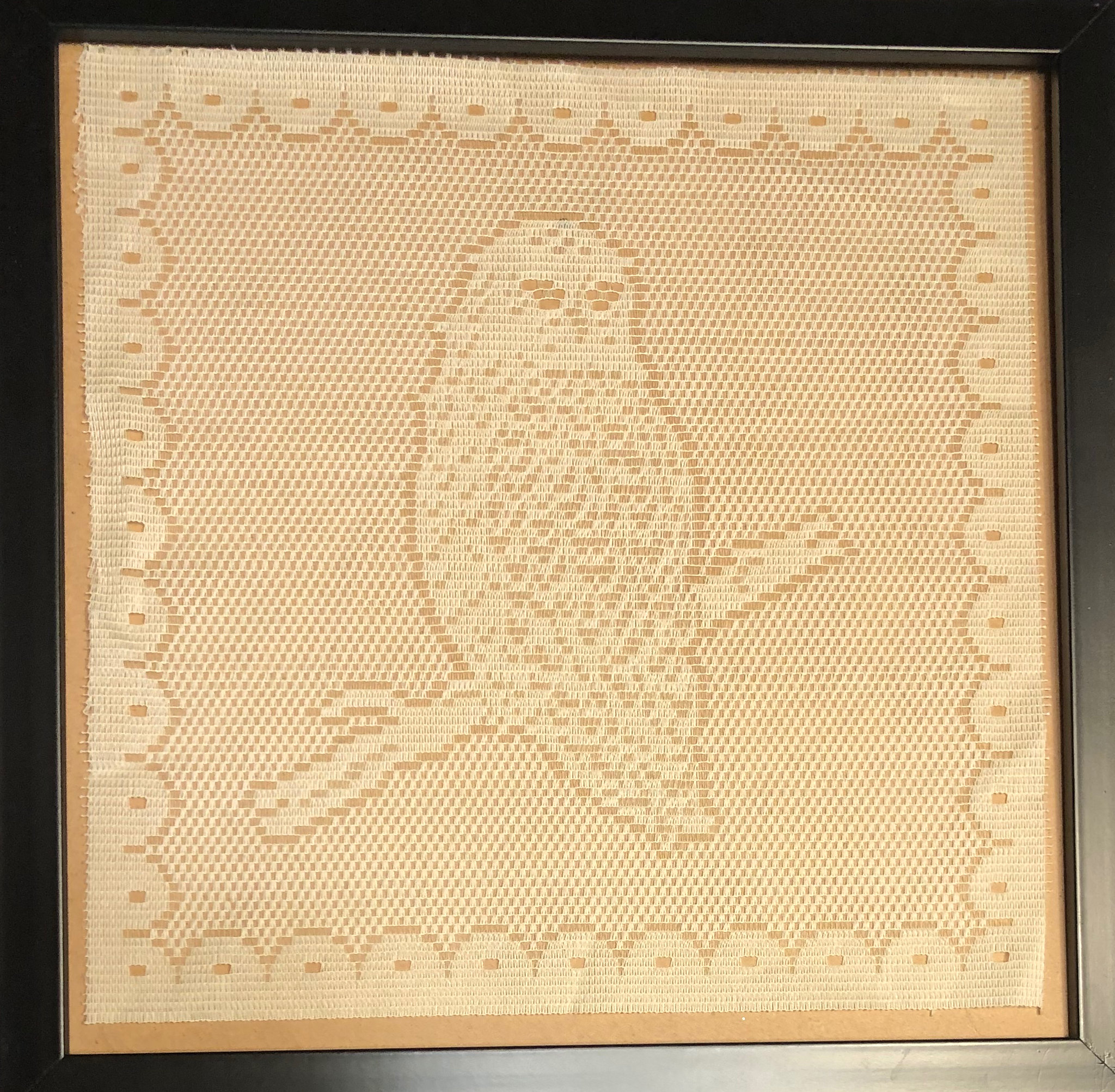
I have plans for these owls, but they are still in progress. I’ll write more after those plans have been completed. I’m still looking for my stash of 12×12 scrapbook papers.


Knitwise? Are you kidding? I mean, I did look at some of my yarn this week. It was somewhat by accident, but that still counts. I think.

I did see a few completed scarves that I will need to donate to the campus “food” pantry. Recently I’ve been trying to work through the extra stuff in my house one box at a time, and this weekend I noticed the scarves. It’s time to move them along to the people who will really need them. If this summer is hotter and drier than expected, I should probably help to prepare for a rugged winter. It might not be the best idea for me to tackle an intricate shawl or a form-fitted sweater, but I can still crank out a warm scarf.

A Facebook memory recently reminded me that I had agreed to teach a Knitting 101 class in the fall of 2020. It was originally planned to be a face-to-face Continuing Education course, but when it went online during the continuing pandemic I backed out. I can barely teach someone to knit in person, let alone on Zoom. Now that we’re back to doing classes in person, the employee who recommended me as a teacher for the course probably isn’t working for my campus anymore.

Nevertheless, if people will need scarves I shall continue to knit them. That’s basic.

Sweet tips for sourdough

Two or three weeks ago, a friend of mine texted me to ask for some information about making sourdough bread. I have never baked sourdough, even once,* but I wasn’t going to let that stop me from offering my advice (being so flattered to receive the request in the first place).

Actually, I haven’t made any bread at all since the pandemic arrived; the bread recipe I used at the time made so much that I had to give away half of what I made. At the time, nobody was exactly looking to bring someone else’s homemade bread into their house. Also, it was at that time that half of America decided to become home baking experts and they bought up all of the grocery store yeast. I couldn’t have made my own bread if I wanted to. It was months before I saw yeast on the shelves again, and by then I was out of the bread-making habit.

Here’s the good news: sourdough is one of the oldest breads, and it seems to be both variable and forgiving. The instructions may seem unusual, especially if you are used to buying bread at the supermarket, but if you are patient and forgiving with yourself and with your starter you will always have bread in your house. And it will get better all the time.

I must admit that I have hundreds of far more cookbooks than I actually need or use. And I have probably given away more than I currently own. But if I had to narrow it down to 10 or 12 cookbooks that I would consult for the rest of my life, two of those books would be The New Laurel’s Kitchen (1986) and The Laurel’s Kitchen Bread Book (1984). These books are such a comfort, and they teach the beginning cook — as well as the experienced cook finding themself in new vegetarian/vegan territory — everything they need to know to make healthy, delicious, soulful food. If you ever see these titles at Half Price Books or a thrift store, purchase them and you will not regret it. If you don’t need them, you will soon know the right person to pass them onto. (Make sure to read the opening essays by Carol Flinders before you give the books away.)

In The Laurel’s Kitchen Bread Book, at least in the edition I have, sourdoughs are discussed in the “desem” section from pages 109 through 133, and in the “rye breads” section from pages 110 to 153. There is also a recipe for saltless bread on page 295 called “Slightly Sourdough”; it calls for the rye sour starter described in the rye section.

A fundamental bread-baking book that I discovered more recently is The Complete Book of Breads (1973) by Bernard Clayton, Jr. (Thanks, Jeff, for the recommendation.) This volume is more scarce than the books from the Laurel’s Kitchen folks, and I consulted a copy from the library until I was fortunate enough to purchase one of my own.

Clayton has a chapter on “Starters” from page 281 to 286, and goes on to cover sourdough breads in the next chapter, from pages 287 to 305. The instructions are friendly yet meticulous; you will not be left wondering what you should do next when you follow one of these recipes.

Clayton went on to publish many editions of this book, as well as other books about breads. My volume may be the classic first edition, but it’s certainly not the only Bernard Clayton book with wisdom to impart about sourdough breadbaking.

These are the books I would recommend as starting points for learning about starters. They’ll give you a wealth of information and hold your hand until you understand enough about the process to make adjustments and go off on your own. Remember that home bakers were feeding their own sourdough starters long before yeast packets were available at the supermarket; some of those pandemic-era bakers might still be keeping their starters going, three years later.

Don’t be afraid to get started!

* Does that Ziploc bag of Amish Friendship Bread count as sourdough? I did keep it moving along a couple of times in the last twenty years or so, but it didn’t stay in my house for more than one batch of bread.


Knitwise, I haven’t done any knitting at all. I have been moving to my new office, keeping up with my reading, and trying to catch up on my reading journal. And I have been driving so much that I need to remember to massage the cramps out of my right leg.

I do think about knitting from time to time, but right now I’m more interested in reading. Perhaps I could read a book about knitting. Several months ago a friend sent me a book by Clara Parkes… if only I knew where I shelved it…

Action at a distance

Right now I seem to be doing most of my tasks via remote control. We will have two or three new academic staff members in my department this academic year, and at the moment my tasks for them consist of initiating processes that other people will complete, communicating via email and social media, and making connections that will be useful in about a month of so. Personally I’m texting, forwarding links, sharing pictures, and electronically brainstorming to help with some future family events. I’m also scheduling potential meetups a week in advance and using map apps to check for road construction two and three states away.

All of this virtual work has become so commonplace that I’m almost shocked when my dog lies down and stretches himself across my foot, or when Youngest approaches with the clear intention of hugging me and rubbing my back. Suddenly it’s all so…close.

A couple of weeks ago I was outside to give the dog his Last Walk of the Day when I noticed how unexpectedly cloudy the night sky was. The temperatures had been consistently topping out in the 80s and 90s and the “lows” were usually in the 60s, so I was surprised to see only the moon and one reddish star with clarity. Everything else was covered up. Then I chuckled at the fact that “all I could see” besides the moon was, in fact, the planet Mars, which was more than 200 million miles away at the time.

Last summer, when things that influenced us from far away were so far out of our control, many of us focused on what was close at hand — mostly what was inside the house. Now that we’re more able to be out and about again, though, I think we’ve become more comfortable with keeping things at arm’s length. It’s easier now to ask for space, to let someone else go first, to wait a bit before moving forward. A bit of hesitation is…safe. There’s no need to rush.

I just bumped my foot into my dog’s side and was reminded, when he startled, that he is a rescue dog. I adopted him from a home that not only gave him up but had, apparently, either traumatized him or exposed him to traumatic events until his reactive behavior became too much to handle. I can never be completely sure of what happened in his first home; I see his reactions to certain events and I can guess.

Doggo can relax now, and profoundly so. But it took him almost a year to be able to let his guard down in my house. He’s going on nine years old and he knows his new name, but he still won’t came when he’s called. He’s not disobedient; he’s wary, looking out cautiously for what might be waiting for him. He’s not fond of surprises or sudden noises, and fireworks and stray gunshots turn my bold terrier into a quivering mass. He’s also beginning to show his age, and not hear or see things as clearly as he used to. More events are going to look like surprises, and he’s probably going to become more defensive as he gets older.

This Welsh Terrier snuggled in a blanket was the closest thing I could find to a picture of a Welshie hiding from ANYTHING.

So there’s no need to rush him, either. We’re all learning to go easy, despite our troubles and traumas. We’ll get there when we get there, and we’ll all feel better if we’re accompanied by happy dogs — whether they’re lying at our feet or romping through the fields barely within sight.

Published in: on August 1, 2021 at 9:00 pm  Leave a Comment  

The Scene of the Crime

For the majority of the last week I was able to entertain myself by working out the details of the murder mystery I have gotten into my head — the suspects and sleuths, the clues and red herrings, and the possible murder weapon — but by the end of the week it was getting a bit unnerving to see my workplace as a crime scene, however imaginary. At one point I thought, I need to put a level on the floor of that room to see if blood would flow across the floor or just pool in place, and then I thought, do I really need to know the answer to that question right now? and I decided that the level could wait for a while.

Campus summers are usually extremely quiet times punctuated at random with sudden, urgent activities. This particular summer shouldn’t be exceptional even though it does have some new elements, including the gradual reintroduction to campus of a large class of employees who’ve been working largely from home for over a year. It’s also a time when I can work on data collection and analysis projects, office moves, and other tasks that are easier to do when almost no one is around (it’s the best time to inventory computers, printers, and phones). This summer we’re also conducting two job searches for academic instructional staff, so there’s that.

Now, with the thought of a fictional murder on the floor, every sound takes on a different meaning. Doors are opened and doors close; lights turn on when someone passes and turn off after a certain interval of inactivity; a phone rings in an office down the hall. If I’m seated at my desk for too long, setting up spreadsheets and crunching numbers, the lights in my own office will go out and I’ll have to pause my work to wave my hands around until the sensors detect my presence and turn the lights back on. “Too long” seems to be fifteen minutes, which doesn’t seem so long to become focused on a task. Nevertheless, every fifteen minutes I have to wave my arms around, every hour I leave my office to take a walk around the building, and every two hours (if I forget to take a walk) my electronically networked wristwatch buzzes to let me know that I’ve been seated for an unacceptable amount of time.

My watch also has an extremely finicky charging system that isn’t compatible with anything else, even other models from the same manufacturer.

The summer is also a popular time for testing emergency systems. You often receive advance warning, but if it’s been a quiet day it’s easy to forget the time and get involved in a project until every desk phone, every cell phone, and every wall-mounted emergency module clicks on and and broadcasts, out of sync with all other devices, “There is a fire in the building!”, “There is a tornado in the area!”, and “Run! Hide! Fight!” for ten minutes. The strobing white lights are an attention-getting bonus. I have tried to update my Excel formulas during an emergency drill; it’s rather difficult. All you can really do during a test is patrol the building and let people know that this is only a test.

But when it’s not loud it’s very, very quiet. So the closing of a door is noticeable, particularly when it isn’t followed by the second closing of a door within a few minutes. And especially so if you don’t know the identity of the person who passed through the door. Why are they here? What business do they have? Are they looking for my office or for someone else’s? Are they going to their own office to work? Did they come to our floor to use our sparkling clean bathrooms or to try their luck at the vending machine? Did everyone who came to the floor also leave? Or is someone lingering in the lounge or down the hall?

Look at the time! Time to get up and take a little walk around, see who’s here….


Knitwise, there wasn’t a clear consensus on the toddler-hat poll results. Maybe I’ll ask the mother-to-be.


I kept up on all of my reading schedules, finishing Dante and the Early Astronomer and then choosing a fascinating book to take its place in the lineup. Months ago I was visiting the university library looking for something else, when I spotted this book and checked it out for its title alone: The Bad-Ass Librarians of Timbuktu.

How could I not want to read this book?

If you like precious manuscripts you are sure to appreciate this book, but it is much more about terror cells in northern Africa, particularly Mali. You also learn a lot about radicalization into extremist Islamic sects. I read six chapters the day I started the book, and finished it two days later. I have no shortage of nonfiction books with which to follow it up, but I haven’t chosen one yet. Stay tuned!

Published in: on May 30, 2021 at 10:11 pm  Comments (1)  

Almost ready to play the guitar

This week I’ve been working on a backup plan for our department’s literature-course poster. We’ve also had a department meeting — via Webex — and I’ve helped with all sorts of tangentially academic matters in the course of the week. I’ve also been studying Hebrew, knitting on the rainbow stripe scarf, watching the WandaVision finale, buying used books, researching the family history (note to ancestors: stay off the heckin train tracks!), feeding the family, doing the laundry, and taking the dog to the vet (for what is delicately referred to as a “sanitary trim” and indelicately as a “baboon cut”). Doing a lot of driving and wishing I were doing more writing. Where has the time gone?

Every time I walk into my bedroom I see two acoustic guitars sitting there on stands, with more dust on them every day. Last summer, while I was hunkered down at home with nowhere to go, I started working through a book on fingerstyle guitar. I learned some scales and songs, and would practice “Happy Birthday” and “Twinkle, Twinkle, Little Star” and “Amazing Grace” in every session. I sat down with the guitar almost every day. No chords, just picking out the notes and learning the strings and fretboard a little, connecting what I learned for the saxophone in high school band to a different musical aesthetic.

Another thing I learned last year is that I’m not really a musician. My brother — now, there’s a musician. Last summer I spent a week at my parents’ house helping my mom cope with my dad’s decline. I took a guitar with me. And on one magical evening my brother Ben came over to visit, picked up the guitar, and freestyled a song and lyrics on the spot, all about our dad and why he shouldn’t wander off, why he should stay home and be happy. Nobody recorded it, and the moment won’t come again. I was almost crying with laughter at the time. The next day, Dad said, “I wish Ben would come over some time. I haven’t seen him in so long.”

That moment had a lot of takeaways. The music and the lyrics delighted me. They entertained my father, even though he didn’t understand what was being said. I think they pleased my mother because they distracted my father. For my brother, perhaps the guitar provided a way to break the tension, divert the energy, and express true feelings all at the same time. (We haven’t talked about it; my family doesn’t talk much about some of the things that really matter.) And my father’s frequent requests to see my brother, complaining that he didn’t see him enough even though he was actually there quite frequently, can be taken at face value. My brother’s company is a hot commodity and none of us get enough of it. He’s fun to have around.

While I was visiting, I picked up the guitar to practice it only once or twice. After I drove back to Wisconsin I placed it on its stand and I haven’t touched it since. School started in August and September, Dad died in late October, I came out for the next week or so, I drove back, then there were holidays and school and a break and more school and here we are.

In the last couple of days I have given some serious thought to picking up the guitar, sitting down with it, picking at the strings and listening to what it says. But I know I’d have to tune it and I’m not quite in the mood to tune it. Maybe next weekend. Maybe. When I’m ready.


Knitwise, last week I did get some knitting done on the rainbow stripe scarf. It’s up to 34 inches and there’s not a lot of yarn left in either ball. I’ll just keep going and see how much scarf I can eke out of it. Then I need to switch to a project I started last year, at the start of the pandemic. It was a bit beyond my capabilities but I thought I could do it, because I liked the people so much for whom I was knitting it. Then every time I sat down to work on it, I struggled. I hope that the next time will go better.


Tomorrow morning I have a COVID test scheduled, followed immediately by a COVID vaccine, shot number one of two. Then I’m back to work, doing whatever I can do to keep things going. Classes, languages, the music of life. That’s just the way it is, baby.

Drawing a blank

About a month ago, after a hiatus of a few years, I started playing Draw Something again. I had originally gotten the app as a way to have a game I could play with my kids, so when I couldn’t use one of my usual usernames I picked something rather more mom-oriented (by this time I had long since forgotten what it was, and had to look it up). I soon realized that a lot of other people were feeling cooped up and in need of a new thing to do, because in my first few hours back in the game I fielded a flurry of new game requests from complete strangers.

Draw Something didn’t always handle the amount of new traffic with ease. It paired me with a player from the Netherlands who was playing in Dutch (when I figured this out I asked Joost to be patient with me, and I never heard from him again). And after a while I realized there was a glitch that made the answer of some puzzles “dresser,” even the other players weren’t drawing anything that looked like a dresser.

After a while I stuck with the handful of players who kept up our streaks (including Daughter, who had urged me to start playing the game again) and stopped responding to new game requests. I was relieved that the men with whom I was exchanging artwork did not seem to be using the game as a way to chat me up, as had happened [TO AN ANNOYING DEGREE] with Words With Friends (which has a chat structure that gives a certain degree of permanence to the conversation). But I did occasionally send and receive ephemeral messages from Daughter, which was fun.

DS - Cleats

One day I was guessing a drawing — “laundry” — in which I suddenly realized that my opponent, who had drawn “clothes pegs” and not “clothespins” to hang her colorful clothes on the line, was not from where I had assumed.

“Where do you live?” I typed into the next message box.

After the next game was finished, a reply popped up: “London. England.”

Our drawings flitted back and forth, and message by brief message we learned about each other in bits and pieces. I had four children, she had three. She was on lockdown, too, and her kids could sometimes be frustrating.

Now that I knew where she was, I could figure out our time difference and guess when she was likely to be able to play. I liked how she played; she didn’t give up and start a new game, as some others had done. She hung in there and guessed until she got it. Our streak grew longer and longer and was quickly into triple digits.

At somewhere over 180 games, she asked, “How long do you think we can keep this streak going?”

“Let’s find out,” I responded.

And then she fell silent.

With our streak paused at 183 games, it has been 23 days since I sent her my last drawing. I don’t know her real name, and tracking her down by her screen name in the game seems as fruitless as anyone trying to find me through mine. But I’m concerned, and I hope that she’s not sick.

There’s a little button in the game that you can press to remind your opponent that it’s their turn. It looks like a poke, or a tiny wagging finger. I don’t want to press it; it seems rude. She knows it’s her turn. She knows that I want to play. She’s just…busy. I’ll wait.

Published in: on May 7, 2020 at 7:19 pm  Comments (4)  
Design a site like this with WordPress.com
Get started