I’m back from a week of traveling, visiting with friends, and doing some research for both of my Primary Projects. I now find myself printing out Wikipedia pages, re-checking passages in support texts, listening to new music, wondering how to plant a backyard garden in the shade of a forest, reviewing and updating my notes, looking up mathematical genealogies (it’s really a thing; have your college math professor’s name handy to plug into the search bar, but only if they finished their dissertation), and ordering mid-1940s science fiction from Amazon.
The annotations that I’m re-checking are the things that I need to see in the best light (which I don’t always have) with my best eyes (these days, I remove my glasses so I can see better). After requesting, receiving, and beginning to read Detecting and Deciphering Erased Pencil Writing by the magnificently named Ordway Hilton, I have already found new ways to look for erased annotations in my Marginal Mystery text. One of my tools is a vintage desk lamp that can deploy an incandescent bulb, a fluorescent bulb, or BOTH bulbs. Now I’m seeing things that I didn’t see before and getting a better look at the things I did notice on my first pass.
I thought I would be double-checking my original list of annotations at this point in the summer, but now I’m adding to it. So when I’m done with this round, I’ll need to triple-check what I have before moving on to another part of the project. One of the reasons that I want to do this section rather completely is that I’d like to be internally consistent with how I’m recording the marks and annotations in my own records. Then, when I move on to other libraries’ copies of the same book, I will be in the habit of recording things in the same way.
Last week I was able to see that the copy of Development of Mathematics owned by the UW-Whitewater library has many more annotations than any copy held by the Ohio University System. Perhaps that says more about the means by which it was acquired. More to come….
I’m delighted to report some major progress with the Impossible Read. I have crossed the halfway point of The Mists of Avalon and I’m now on page 474. It’s becoming a story that I want to sit with and really pay attention to; many of the things it has going on are very different from the events in The Once and Future King. Of course, these authors and their audiences are also extremely different, and perhaps that’s all that I need to say about that. The same will probably also be true of Lev Grossman’s The Bright Sword when I’m able to start it.

But before I take on something so contemporary, I will have a copy of Mark Twain’s A Connecticut Yankee in King Arthur’s Court to read. It shouldn’t be hard to find ways to view its 1949 and 1995 film adaptations. Then it will be time for The Bright Sword, which should close out our section on Arthurian legend.
What’s next? I shall consult with the members of my department (they do teach, write, and appreciate literature, after all), but right now I think the next book up is The Epic of Gilgamesh. If we start it before 2025 I will be absolutely stunned.
After a closer examination, I can state with some confidence that the Sears Achiever I acquired last week (via a friend of my mother) was manufactured in 1977 or 1978. It’s a nice little typer with a good ribbon, and just needs a cleaning. It came in a tidy little case that will also receive a light cleaning.

I have also come into the possession of an IBM electric typewriter dating from 1972: a Model D. I made the offer on it because of the seller’s memories of typing on it at his father’s office. (I had similar memories at my father’s office, but I was instead enthralled with a manual staple remover. Maybe my ownership of a manual typewriter made me less inclined to seek out other typewriters during those tender years.)
Unfortunately, the machine (“Rodger”) did not power up when I plugged it in. That’s one of the reasons I have chosen not to collect electric typewriters: the extra variable about which I know nothing. This past weekend I encountered two electric typingwriters at two different Goodwill locations, and I was satisfied with tucking them back into their plastic cases for some other collector to discover. But I would like to get this one up and working, if it’s not too much trouble. I have already lugged all 40 pounds (or so) of it to the office. [GOSUB “sunk-cost-fallacy” / RETURN]
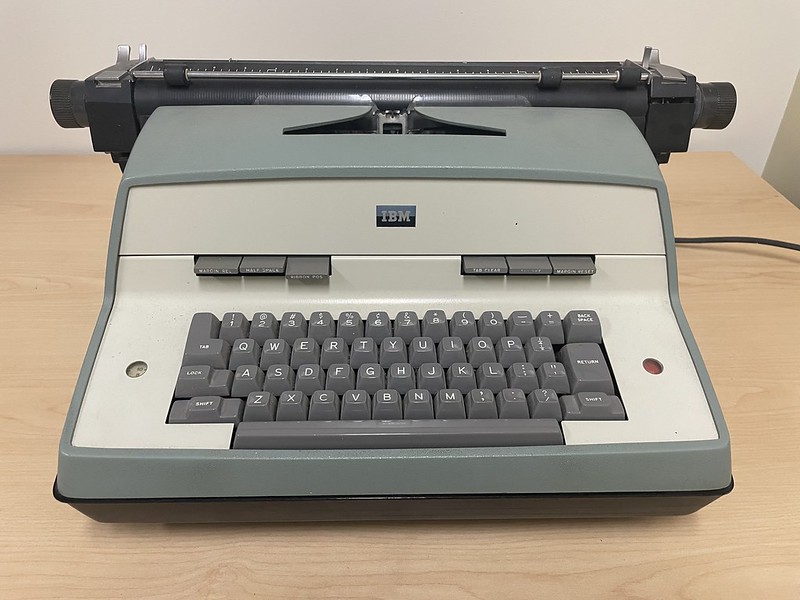
It has a 0.5 horsepower motor, from what I can see in the owner’s manual. Typewriter repairmen learned to fix those back in the day, and I can learn, too — if I can find a copy of the service manual.
Knitwise, I didn’t take any knitting projects with me on vacation. But I did dart into a big-box craft store and pick up a pair of US 8 single-point bamboo needles so that I can move on to the next stage of the pattern. One does what one must.
I also spent some time picking out machine stitches of my mother’s quilting project. Dazzled by the softness of a microfiber flat sheet, she used it as the backing of a hand-pieced quilt top. When she saw the error of her ways — the sheet shifted under the machine stitching — she was too frustrated to think of how to take a step backwards and release the backing from the top. Before she was able to resort to using a pair of scissors, I intervened and sat down a couple of times with a manual seam ripper and picked out a few sets of stitches. The rest is up to my mother and her patience.


 Chocolate Sheep