Life in the slow lane

Recently I had an incident with my car that resulted in a flat tire. In the olden days of just a few years ago I would have pulled out my AAA card, used my cell phone to call the number on it, and spoken with a representative to find out when someone could come to my location and provide roadside assistance. After this incident, however, I pulled out my iPhone, downloaded the AAA app from the cloud, and logged in to the app to make a report. I received an ETA of 20 minutes, and the app alerted me when the driver had arrived. In between all those steps I met a friend for lunch to discuss my book project (cf. last week’s post).

The tow driver installed my spare tire and put the flat tire (and wheel) in the back of my car, then cautioned me to drive slowly on the spare — not over 40 mph and for not more then 500 miles. I then called my mechanic and let him know about the situation. He asked for the numbers on the side of my tire and found that he didn’t have one in his current inventory. He would get one — and he cautioned me to drive slowly on the spare. My co-workers cautioned me to drive slowly on the spare.

Fortunately, the incident happened on a Thursday. Traffic along my way to work was very light on Friday and I grounded myself for the weekend so I wouldn’t have to drive on the spare at all. On Monday morning I crept along the country roads to work, careful not to exceed 40 (or 45) mph. On Tuesday morning Jim had a tire for me. Before going to work I drove slowly to his shop, pulling over when there were impatient drivers behind me.

After the regular tire was installed and the spare was safely tucked away in the rear cargo compartment, the car felt like it was tipping to the left — my first clue that I had adjusted too quickly to the car’s imbalance when the spare was on.

My second clue was that, on my drive to work, my speed now naturally topped out at 40-45 mph. Evidently, I’d grown accustomed to that pace.

I’m still getting used to driving on four wheels of the same size, and I’m gradually picking up speed.


I didn’t acquire any additional typewriters in the last week, but a friend texted me photos this morning and asked my preference of two vintage models. So, something may be arriving soon — perhaps a brand with which I’m not already familiar. So much for my resolution to stick to Smith-Coronas (and Underwoods).

I’ve been thinking a lot about the book project and came up with some ways that will be helpful for me to organize the information I already have and plan for the book as well as any other writing I might be able to do on the subject. Before I could take action, two of my sons visited for the weekend and talked me into going shopping. Our shopping excursions usually involve thrift store and used book stores, so it wasn’t hard for them to twist my arm. But after all of that was over, I made some changes in the library that game me more space to arrange my resource materials.

Home library, east wall, April 2023.

The above photo will give you an idea of what this corner of my library looked like this morning. Actually, it was worse than this: stacks of paper cartons, filled with books, topped with piles of other books, blocked the bottom two shelves of the bookcase on the right. Since I didn’t take a “before” photo this morning, you’ll just have to take my word for how much worse it was.

Wait a minute! I did take a photo, but not until I had moved those boxes and piles to the other side of the room. Here they are:

What could possibly be in that large blue box?

Anyway, I moved those boxes over there so I could haul the cube unit upstairs, along with the sheet music it held (for piano, guitar, saxophone, and recorder), the framed poster of a guitar chord chart, a trumpet, and a tenor saxophone. That left me with this:

Oh, this space won’t be empty for long.

After pondering when I might be able to purchase another bookcase I recalled that I already had a bookcase in the garage, which I was storing for a friend. When the friend confirmed that he didn’t need it right away, I developed a plan.

ta daaaaaaah

The next step in this process was to reorganize my math and physics books, starting with the cosmology/astronomy shelf (to left left in the above picture) and working downwards. Some of the math books had gotten into the physics section, and some of the physics books had gotten into the math section. It was kind of a chocolate/peanut butter situation, but today I was deconstructing the Reese’s Cup to put the ingredients in separate places.

Here’s what it looks like now:

What should go on the wall?

The book’s source materials are organized — as well as my books on the Manhattan Project and on Albert Einstein — and my math bookcase is seriously decluttered. I still have some topical rearranging to do, so that might do away with the double-stacking on the bottom three shelves.

After Saturday’s shopping trip I felt as if I had been hit by a truck, but it was Sunday on which I scrubbed and carried bookcases, hauled boxes, and re-shelved dozens of books. Fortunately, the fall semester is approaching quickly, and I should have plenty of time to rest and recuperate.


Knitwise, I was so busy last week from minute to minute, hour to hour, and day to day that I haven’t even ripped back the owl wrist warmers yet. Maybe this week.

Nothing to lose

The title of this post is the refrain I’ve been hearing all week long, from myself and others. Last Monday I discovered an opportunity to take one of my writing projects a huge step forward. The opportunity itself is so big that just applying for it is something that I can add to my resume (after I upload my resume with the application, of course). The opportunity isn’t code for “new job,” by the way; it’s a chance to get some funded project support and get connected to the university press community. So no worries there — I can stay in the same job and the same graduate program where my next class will start in just over two weeks. As you can imagine, I’ll have simply gobs of spare time and I won’t know what to do with myself. Now, never fear! I can also work on my book with more determination.

What happens if I don’t apply for the support? Well, nothing. Nothing happens. So I have nothing to lose. And that realization has given me all kinds of little courage. Make an appointment to talk to someone on campus about how to revise my resume and fill out this application? Why not? I have nothing to lose. Create a detailed outline of the project? Nothing to lose. Start actually writing sections of the book? Nothing to lose. Send blind emails to famous scholarly people to request information I can use in the book? Nothing to lose.

The book, the book, the book. Over the weekend it has become much more real, much more than a “project.” When I finished writing the outline on Saturday morning, I knew in my bones that what I was really working on was a BOOK.

I’ll try to make it a book that you will want to read, will enjoy reading, and will be glad that you’ve read.

This particular opportunity sort of dropped into my lap (via my email in-box) when I wasn’t looking for it. But I’m getting so much energy from just the thought of the application process that I plan to actively look for other programs that might help me as I write the book. That energy can carry over (I hope) to my other project and place it in the “book development” category as well.

Why shouldn’t I write a book? I have nothing to lose.


The Impossible Read continues, slowly. Last week I chatted about it to someone new, and while his eyes did widen his reaction wasn’t “you must be crazy” but rather “aren’t you going to read the Aeneid?” So he’ll definitely be consulted on the order of books when I arrive at the Greek and Roman section.

Right now I’m on page 555 of The Mists of Avalon, with six more chapters to go in section three, “The King Stag.” It’s all downhill from there, for me and for Camelot.


Knitwise, I have been staring at the owl wrist warmers and their project bag all week, but I haven’t touched them. After I publish this post I will slip the stitches off the needle, wind up the yarn, and cast on again. I should have run in a lifeline at the end of the ribbing section, but it’s not really much of a bother. It’s a problem I can solve, and I’ll make sure to do the new knitting in good light, reduce distractions during my knitting time, and rewrite the cabling instructions so that I’m always looking in the right place for what to do next. This is a little project with just a little trickiness. I can do it.

P.S. If you don’t see me on Facebook these days, don’t worry about it. I’m taking a break and I don’t know when I’ll be back. I will continue to share these posts on my Facebook page. If you’re also taking a Facebook break, you should be able to click somewhere on the post to subscribe so that my future posts will be delivered to you via email. What do you have to lose?

From the bottom of my list

For the last several months I’ve been using a neat app called Habitica to help me, well, develop good habits. You can use it as a personal checklist, but the real fun — and support — begins when you join up with a virtual party of other habit-forming adventurers and do D&D-type “quests” against foes like laziness and recidivism. You choose a class (I’m a healer) and earn various critter eggs that you hatch with various potions, and you feed the resulting critters with food drops that happen after you finish the tasks on your list.

There are three types of lists that you keep: Habits, which are actions you are trying to cultivate; Dailies, which are the things that you try to do every day; and Tasks, which are the other to-dos that pop up. Habits are color-coded as yellow, and they change toward blue and then green the more often you do them. Dailies are blue; you do them or you don’t, and a fresh blue list shows up every morning. Tasks are initially yellow, but turn orange, then red, then dark red the longer they are left undone (ask me how I know).

You could, of course, just delete the Tasks that you leave undone. But if your party is counting on you in the big Boss Battle against sloth, you want to finally finish off that old, dusty Task and give sloth a great big wallop. Then the whole party gets more experience points, potions, critter eggs, or what-have-you. Maybe it sounds silly, but it’s a lot more fun than just making lists on Post-Its every day, then beating yourself up for not getting everything done. I have actually developed some better habits after using the app for a while.

I’m giving you this background so that it will make sense when I tell you that, this week, I’ve started to look at the Tasks list and see if I can’t work from the bottom up and finally finish some of the oldest tasks. Do I get more hit points that way? Maybe. The one thing the game doesn’t do very well is explain how every little bit of it works. Some members of my party have been using the app for years and it feels like we’re all figuring it out together. But I hope that the coding underlying the app has factored in the deep satisfaction you get after you finally take care of the first task you set for yourself a long time ago.

I’ve been getting research done for Black Walnut, in the form of listening to more bluegrass music. But it’s for Marginal Mystery that I’ve really been working. I finished reading the book about deciphering pencil erasures, I re-checked all of the annotations that I noted in my local copy of Development of Mathematics, I am in the process of negotiating with two friends who can serve as field reviews for copies of the book held on other campuses, I updated my list of university-held copies of both editions of the book, and I finally broke down and ordered a copy of the science fiction novel that my math-historian author wrote under a pen name at the same time he was writing Development of Mathematics. As if revising a 550-page math history into a 595-page math history wasn’t enough, he was also composing a complex time-travel novel. And teaching university-level math classes. I cannot understand how he cranked out so much content in less time than it takes to read it. Usually these things seem to work out the other way around.

Last weekend I finally took one more step in a huge project that I originally thought I would be able to complete in mid-March. It started taking on so much more complexity that I needed to give myself a break, quit kicking myself for not getting it done, and be more realistic about the amount of time that it would require to do it well. Now I have worked out a process for getting each section done, and it will be done when I say it’s done. (I’ll be sure to let you know.) It involves watching a lot of movies, being thoughtful about the movies, drafting reviews, and collecting all of the screenshots and other images that I need in order to complete my review. I hope that it will be worth the wait. I’m able to enjoy the process — now that I’m not rushing at an impossible pace.


The Impossible Read is coming along well; most days I am able to sit down to read the next chapter in The Mists of Avalon. I’m currently on page 544 and looking forward to each twist and turn in the plot. I can sum it up at the moment by saying that things are soon going to get much worse for everybody. (Tl;dr: keep your vows, people.) And I have a courtside seat better than the one from which Jack Nicholson watches the Lakers.


Knitwise, I was so proud of myself for finally moving forward on my owl-themed wristwarmer. Recently I bought the needles that were necessary, and on Friday I knitted the next few rows before the cables.

Don’t do the cables yet, I told myself — do those at home, in good light.

I ignored myself and pushed forward, even though I had trouble looking up the acronyms for the different cabling instructions.

Stop now, I told myself before row 7.

I ignored myself and pushed forward.

This pattern has a mistake, I told myself when I finished row 7. It really ends with 4 knitted stitches instead of 6.

I ignored myself and stared at the project and at the pattern for a while.

Oh, wait, I started to tell myself. Perhaps I am wrong and the professional designer of this published pattern is correct. Maybe I looked at the wrong instructions or didn’t understand the instructions.

Then I tried to undo the row, which was a bit difficult considering (a) it was black yarn in a wool/alpaca blend, (b) I was undoing cabling sections, and (c) I had not done all of the cabling sections correctly. Which sections had I done correctly? Which sections had I done incorrectly? More precisely, what had I done wrong and how could I possibly undo it if I didn’t know what I did?

Now the knitting is in the project bag and I’m in time out until I understand what I did wrong and promise not to do it again. I may have to start over completely, from the cast-on. We’ll see if that is enough for me to learn my lesson.

In a different light

I’m back from a week of traveling, visiting with friends, and doing some research for both of my Primary Projects. I now find myself printing out Wikipedia pages, re-checking passages in support texts, listening to new music, wondering how to plant a backyard garden in the shade of a forest, reviewing and updating my notes, looking up mathematical genealogies (it’s really a thing; have your college math professor’s name handy to plug into the search bar, but only if they finished their dissertation), and ordering mid-1940s science fiction from Amazon.

The annotations that I’m re-checking are the things that I need to see in the best light (which I don’t always have) with my best eyes (these days, I remove my glasses so I can see better). After requesting, receiving, and beginning to read Detecting and Deciphering Erased Pencil Writing by the magnificently named Ordway Hilton, I have already found new ways to look for erased annotations in my Marginal Mystery text. One of my tools is a vintage desk lamp that can deploy an incandescent bulb, a fluorescent bulb, or BOTH bulbs. Now I’m seeing things that I didn’t see before and getting a better look at the things I did notice on my first pass.

I thought I would be double-checking my original list of annotations at this point in the summer, but now I’m adding to it. So when I’m done with this round, I’ll need to triple-check what I have before moving on to another part of the project. One of the reasons that I want to do this section rather completely is that I’d like to be internally consistent with how I’m recording the marks and annotations in my own records. Then, when I move on to other libraries’ copies of the same book, I will be in the habit of recording things in the same way.

Last week I was able to see that the copy of Development of Mathematics owned by the UW-Whitewater library has many more annotations than any copy held by the Ohio University System. Perhaps that says more about the means by which it was acquired. More to come….


I’m delighted to report some major progress with the Impossible Read. I have crossed the halfway point of The Mists of Avalon and I’m now on page 474. It’s becoming a story that I want to sit with and really pay attention to; many of the things it has going on are very different from the events in The Once and Future King. Of course, these authors and their audiences are also extremely different, and perhaps that’s all that I need to say about that. The same will probably also be true of Lev Grossman’s The Bright Sword when I’m able to start it.

But before I take on something so contemporary, I will have a copy of Mark Twain’s A Connecticut Yankee in King Arthur’s Court to read. It shouldn’t be hard to find ways to view its 1949 and 1995 film adaptations. Then it will be time for The Bright Sword, which should close out our section on Arthurian legend.

What’s next? I shall consult with the members of my department (they do teach, write, and appreciate literature, after all), but right now I think the next book up is The Epic of Gilgamesh. If we start it before 2025 I will be absolutely stunned.


After a closer examination, I can state with some confidence that the Sears Achiever I acquired last week (via a friend of my mother) was manufactured in 1977 or 1978. It’s a nice little typer with a good ribbon, and just needs a cleaning. It came in a tidy little case that will also receive a light cleaning.

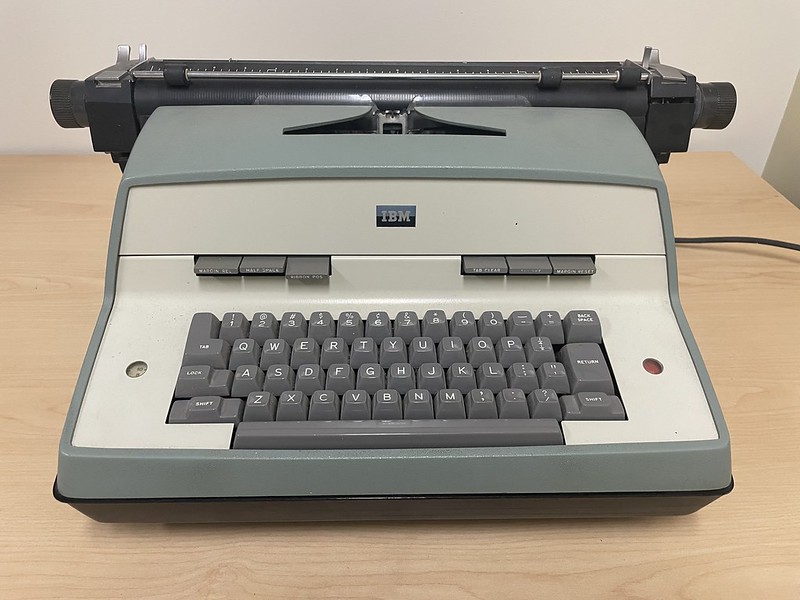
I have also come into the possession of an IBM electric typewriter dating from 1972: a Model D. I made the offer on it because of the seller’s memories of typing on it at his father’s office. (I had similar memories at my father’s office, but I was instead enthralled with a manual staple remover. Maybe my ownership of a manual typewriter made me less inclined to seek out other typewriters during those tender years.)

Unfortunately, the machine (“Rodger”) did not power up when I plugged it in. That’s one of the reasons I have chosen not to collect electric typewriters: the extra variable about which I know nothing. This past weekend I encountered two electric typingwriters at two different Goodwill locations, and I was satisfied with tucking them back into their plastic cases for some other collector to discover. But I would like to get this one up and working, if it’s not too much trouble. I have already lugged all 40 pounds (or so) of it to the office. [GOSUB “sunk-cost-fallacy” / RETURN]

It has a 0.5 horsepower motor, from what I can see in the owner’s manual. Typewriter repairmen learned to fix those back in the day, and I can learn, too — if I can find a copy of the service manual.


Knitwise, I didn’t take any knitting projects with me on vacation. But I did dart into a big-box craft store and pick up a pair of US 8 single-point bamboo needles so that I can move on to the next stage of the pattern. One does what one must.

I also spent some time picking out machine stitches of my mother’s quilting project. Dazzled by the softness of a microfiber flat sheet, she used it as the backing of a hand-pieced quilt top. When she saw the error of her ways — the sheet shifted under the machine stitching — she was too frustrated to think of how to take a step backwards and release the backing from the top. Before she was able to resort to using a pair of scissors, I intervened and sat down a couple of times with a manual seam ripper and picked out a few sets of stitches. The rest is up to my mother and her patience.

Design a site like this with WordPress.com
Get started